
Disruption Through Specialization
It has been hypothesized that disruptions in medical care will be partly driven by the commoditization of certain procedures. While hospitals can address almost any ailment, their level of expertise and flexibility comes with a significant overhead cost. There are many diseases that can be diagnosed and treated without need for the wide range of expertise available in hospitals - consider for example the array of services offered by nurses in retail clinics like [Target](http://www.target.com/c/clinic-services-health/-/N-4yia4#?lnk=lnav_ clinic_1&intc=2413603|null)and Walmart. For health systems that share some of the cost when patients get sick, efficient care delivery is quickly becoming critically important.
One of the most effective methods to lower health system costs is the creation of specialty clinics. These clinics save money by streamlining patient flow for specific treatments and moving part of the burden of administering treatment to skilled but lower cost staff. Additional benefits of this approach to care delivery include a greater level of consistency and clear performance metrics that are relevant to the specific therapy being delivered.
While the benefits of moving patients out of high-cost hospital settings and into lower cost specialty clinics are significant, it isn't obvious which patients and procedures are best suited to this approach. In this article we examine whether the 2012 Medicare Part B claims data can help us find providers that have focused their practice for the delivery of specific therapies, whatever the reason for that focus.
Proceduralists. There are a little over 46,000 proceduralistsin the Medicare data set; these are healthcare providers earning greater than 90% of their Medicare income from repeated applications of a single procedure. Figure 1 compares the number of procedures performed to total dollars earned from that procedure for all physicians in the data set and highlights similar results for proceduralists.
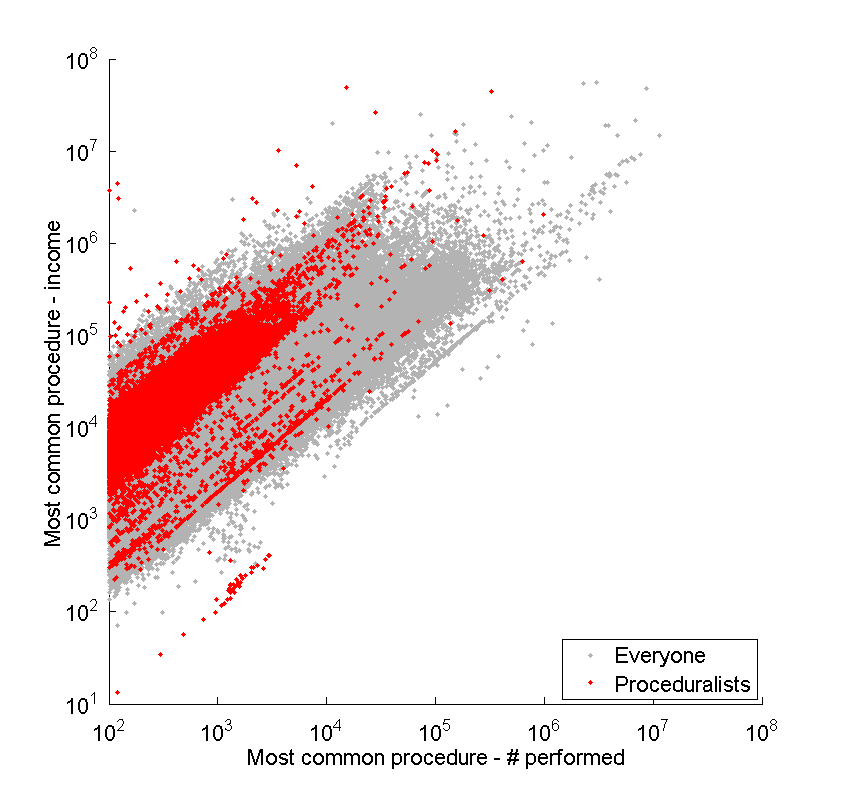
Approximately half of the proceduralists are chiropractors with an additional 12,000 social workers, clinical psychologists and psychiatrists making up the next most common types of healthcare provider to specialize in just one procedure. Providers in these categories appear to be fundamentally different from other providers in multiple ways; for example, they are also among the least likely to see Medicare patients or to "accept assignment" when they do take Medicare patients. Because there are so many of these practitioners, the procedures they focus on tend to receive the largest total dollars from Medicare (Table 1) even though the amount earned by each practitioner is not particularly high.
Hemophelia. One of the procedures with high total expenditure that is not explained by the large number of practitioners is "Factor VIII recombinant NOS". This has been the focus of a previous article on opportunities to lower Medicare costs by changing incentive patterns. That article pointed out the opportunity to save an average of $10,000/month per patient by moving those patients to the non-recombinant version of Factor VIII. There are only 8 Factor VIII proceduralists; nonetheless there is the opportunity to save Medicare multiple millions of dollars by modifying the practice behavior of just these 8. (In fact, there are only 5 since Accredo Health Group Inc. accounts for four locations in California, North Carolina, Florida and New Jersey). We note that there are no proceduralists focused on the treatment of factor VIII deficiency who are using the lower cost version of this medication - presumably because of the backwards financial incentive structure built into the Medicare fee schedule.
Home INR monitoring. Among proceduralists, code G0249 is the single procedure that accounts for the highest income per provider (first line of Table 2). This is intended for providers of kits for in-home monitoring of blood clotting; monitoring of this type is typically intended for patients who are on blood thinners and need to ensure that they are not over or under medicating. While the average income of $10 million per lab that specializes in this procedure sounds exorbitant, these 8 labs manage home monitoring for over 120,000 patients. Because of the high levels of morbidity and mortality associated with poorly managed blood thinners, $650/year per patient spent on home monitoring is probably an excellent investment.
Drugs. There are a number of proceduralists making over $100,000 (gross) from the administration of particular drugs. These include the cancer drugs Ipilimumab and Bevacizumab, drugs for immune deficiency (Octagam, Gamunex, Privigen, Immune Globulin), Natalizumab for Crohn's disease and Multiple Sclerosis, Imuglucerase for Gaucher's Disease, Infliximab for Rheumatoid Arthritis and Crohn's disease and Omalizumab for asthma. Each of these drugs has from 1 to 3 proceduralists focusing on their therapeutic use with the exception of Infliximab and Natalizumab (8 and 11 proceduralists respectively).
It is difficult to believe that differences in patient population can explain the presence/absence of proceduralists in different markets. For example, 4 of the 11 Natalizumab proceduralists operate in the same practice in Raleigh, NC, and the only Octagam proceduralist practices in Irving, Texas. If we do not believe that there is a disproportionate percent of the population in Irving with immune deficiency, we must conclude that either (1) building a practice that focuses on this procedure has increased the efficiency of treating this population or that (2) some patients in Irving are being overtreated with Octagam.
Conclusion. There are a total of 332 procedures for which there exists at least one proceduralist provider. Examples of billable procedures, other that the few we have already mentioned, include miles traveled for the collection of blood to be used to in laboratory tests, movement of portable x-ray machines, management of end stage renal disease, various examinations of tissue samples by pathologists and others.
Without more extensive research, it is difficult to determine whether any particular proceduralist is boosting the efficiency of the healthcare delivery in the systems in which they work or whether they are overusing their procedure of choice. In either case, there is tremendous opportunity to boost the efficiency of healthcare delivery by identifying these practitioners and either emulating them more broadly or encouraging them to modify their practices.
Table 1 - Specialty procedures sorted by the total dollars earned by practitioners focused on those procedures.
| Code | Description | Cost per procedure | # Specialists | Total $ | Average Income |
| 98941 | Chiropractic manipulation | $34.30 | 14433 | $286,515,905 | $19,851.44 |
| 90806 | Psytx off 45-50 min | $72.00 | 8031 | $167,043,144 | $20,799.79 |
| 88305 | Tissue exam by pathologist | $70.20 | 544 | $165,598,150 | $304,408.36 |
| 99214 | Office/outpatient visit est | $83.00 | 2436 | $84,513,755 | $34,693.66 |
| 98940 | Chiropractic manipulation | $25.20 | 6341 | $84,096,788 | $13,262.39 |
| G0249 | Provide INR test mater/equip | $119.00 | 7 | $73,450,450 | $10,492,921.43 |
| 99213 | Office/outpatient visit est | $56.80 | 2875 | $73,368,938 | $25,519.63 |
| 84999 | Clinical chemistry test | $1,160.00 | 6 | $58,602,711 | $9,767,118.50 |
| 90862 | Medication management | $55.40 | 1946 | $49,367,138 | $25,368.52 |
| J7192 | Factor viii recombinant NOS | $12,500.00 | 8 | $36,599,248 | $4,574,906.00 |
| 98942 | Chiropractic manipulation | $44.20 | 1410 | $33,290,713 | $23,610.43 |
| 93229 | Remote 30 day ecg tech supp | $650.00 | 6 | $30,048,559 | $5,008,093.17 |
| 97110 | Therapeutic exercises | $28.10 | 1073 | $28,860,561 | $26,897.07 |
| 90807 | Psytx off 45-50 min w/e&m | $100.00 | 894 | $28,161,756 | $31,500.85 |
| 90960 | Esrd srv 4 visits p mo 20+ | $259.00 | 175 | $22,660,952 | $129,491.15 |
| J3490 | Drugs unclassified injection | $678.00 | 10 | $15,690,592 | $1,569,059.20 |
| 90805 | Psytx off 20-30 min w/e&m | $69.10 | 640 | $14,703,880 | $22,974.81 |
| 90818 | Psytx hosp 45-50 min | $67.10 | 239 | $13,985,234 | $58,515.62 |
| 99215 | Office/outpatient visit est | $126.00 | 308 | $12,285,748 | $39,888.79 |
| 64450 | N block other peripheral | $53.30 | 25 | $10,980,400 | $439,216.00 |
| 86849 | Immunology procedure | $2,820.00 | 1 | $10,145,033 | $10,145,033.00 |
| 90808 | Psytx office 75-80 min | $103.00 | 248 | $10,012,582 | $40,373.31 |
| 90804 | Psytx office 20-30 min | $53.70 | 219 | $7,072,871 | $32,296.21 |
Table 2 - Specialty procedures sorted by the average income of providers focused on those procedures. Note that this representation may be misleading as there are instances in which all providers within a practice are aggregated into a single provider in the Medicare data.
| Code | Description | Cost per procedure | # Specialists | Total $ | Average Income |
| G0249 | Provide INR test mater/equip | $119.00 | 7 | $73,450,450 | $10,492,921.43 |
| 86849 | Immunology procedure | $2,820.00 | 1 | $10,145,033 | $10,145,033.00 |
| 84999 | Clinical chemistry test | $1,160.00 | 6 | $58,602,711 | $9,767,118.50 |
| 93229 | Remote 30 day ecg tech supp | $650.00 | 6 | $30,048,559 | $5,008,093.17 |
| J7192 | Factor viii recombinant NOS | $12,500.00 | 8 | $36,599,248 | $4,574,906.00 |
| J9228 | Ipilimumab injection | $103.00 | 2 | $5,524,475 | $2,762,237.50 |
| L9900 | O&P supply/accessory/service | $1,720.00 | 2 | $4,273,886 | $2,136,943.00 |
| 0297T | Ext ecg scan w/report | $263.00 | 1 | $1,635,151 | $1,635,151.00 |
| J3490 | Drugs unclassified injection | $678.00 | 10 | $15,690,592 | $1,569,059.20 |
| J1786 | Imuglucerase injection | $41.30 | 3 | $4,682,398 | $1,560,799.33 |
| G0166 | Extrnl counterpulse, per tx | $141.00 | 3 | $3,231,791 | $1,077,263.67 |
| J1561 | Gamunex/gamunex c | $37.60 | 1 | $1,003,937 | $1,003,937.00 |
| J9035 | Bevacizumab injection | $55.80 | 3 | $2,727,958 | $909,319.33 |
| 83901 | Molecule nucleic ampli addon | $19.70 | 1 | $757,658 | $757,658.00 |
| 96102 | Psycho testing by technician | $73.00 | 1 | $650,552 | $650,552.00 |
| G9152 | Mapcp demo community | $4.80 | 8 | $4,958,309 | $619,788.63 |
| J1568 | Octagam injection | $37.90 | 1 | $543,460 | $543,460.00 |
| J2323 | Natalizumab injection | $11.20 | 11 | $5,761,235 | $523,748.64 |
| 64450 | N block other peripheral | $53.30 | 25 | $10,980,400 | $439,216.00 |
| J1459 | Inj IVIG privigen 500 mg | $32.00 | 2 | $859,256 | $429,628.00 |
| 46500 | Injection into hemorrhoid(s) | $210.00 | 1 | $415,388 | $415,388.00 |
| 36516 | Apheresis selective | $571.00 | 1 | $406,277 | $406,277.00 |
| 93293 | Pm phone r-strip device eval | $48.00 | 9 | $3,106,620 | $345,180.00 |
| J1745 | Infliximab injection | $59.40 | 8 | $2,747,242 | $343,405.25 |
| 17004 | Destroy premal lesions 15/> | $167.00 | 2 | $678,976 | $339,488.00 |
| 88305 | Tissue exam by pathologist | $70.20 | 544 | $165,598,150 | $304,408.36 |
| 93271 | Ecg/monitoring and analysis | $135.00 | 1 | $301,946 | $301,946.00 |
| 99183 | Hyperbaric oxygen therapy | $202.00 | 9 | $2,437,519 | $270,835.44 |
| G0399 | Home sleep test/type 3 Porta | $162.00 | 3 | $776,218 | $258,739.33 |
| 90802 | Intac psy dx interview | $139.00 | 1 | $236,990 | $236,990.00 |
| 36478 | Endovenous laser 1st vein | $1,200.00 | 4 | $935,864 | $233,966.00 |
| 37227 | Fem/popl revasc stnt & ather | $2,280.00 | 1 | $230,344 | $230,344.00 |
| J1566 | Immune globulin, powder | $28.70 | 1 | $224,439 | $224,439.00 |
| P9603 | One-way allow prorated miles | $0.98 | 7 | $1,521,184 | $217,312.00 |
| 36475 | Endovenous rf 1st vein | $760.00 | 8 | $1,656,120 | $207,015.00 |
| 88348 | Electron microscopy | $569.00 | 1 | $190,451 | $190,451.00 |
| 77522 | Proton trmt simple w/comp | $784.00 | 1 | $181,031 | $181,031.00 |
| 95951 | EEG monitoring/videorecord | $996.00 | 4 | $710,637 | $177,659.25 |
| 90814 | Intac psytx off 75-80 min | $100.00 | 2 | $338,108 | $169,054.00 |
| 86481 | Tb ag response t-cell susp | $97.00 | 2 | $334,498 | $167,249.00 |
| G0431 | Drug screen multiple class | $78.00 | 15 | $2,465,313 | $164,354.20 |
| J2357 | Omalizumab injection | $22.20 | 3 | $443,261 | $147,753.67 |
| 88304 | Tissue exam by pathologist | $62.70 | 2 | $291,353 | $145,676.50 |
| L8680 | Implt neurostim elctr each | $300.00 | 3 | $411,375 | $137,125.00 |
| 88346 | Immunofluorescent study | $94.00 | 1 | $131,942 | $131,942.00 |
| 90960 | Esrd srv 4 visits p mo 20+ | $259.00 | 175 | $22,660,952 | $129,491.15 |
| 86353 | Lymphocyte transformation | $47.60 | 1 | $119,647 | $119,647.00 |
| 17108 | Destruction of skin lesions | $618.00 | 1 | $109,377 | $109,377.00 |
| 93306 | Tte w/doppler complete | $151.00 | 42 | $4,576,030 | $108,953.10 |
| 95811 | Polysomnography w/cpap | $483.00 | 1 | $104,329 | $104,329.00 |
| 11042 | Deb subq tissue 20 sq cm/< | $79.70 | 4 | $403,377 | $100,844.25 |
Approach. We identify proceduralists based on the percent of gross allowed payments from Medicare assigned to a certain procedure compared to total gross allowed Medicare payments. Providers who derive greater than 90% of their gross income from a single procedure are designated proceduralists. We look only for providers who have a total of at least 100 procedures recorded in the data. Because of the way the data are filtered, physicians who are eliminated by this criterion are unlikely to be specialists unless they work almost exclusively with patients under the age of 65 (ie. not covered by Medicare).
Originally published on EHR Analytics, 2015.
Comments
Loading comments…